Sri Lanka may be a small country, but spiritually it feels vast. Within a single afternoon you can pass a golden reclining Buddha, a riotously colourful Hindu temple tower, a striped mosque rising above a busy Colombo street, or a Catholic church boasting a towering statue of Jesus on the cross or the Virgin Mary.
Religion here isn’t tucked away — it’s visible, audible and woven into daily life. s
Buddhism: The Spiritual Backbone of Sri Lanka
About 70% of Sri Lankans are Buddhist, and it shows. There are roughly 6,000–7,000 Buddhist temples across the island, far more than any other place of worship, ranging from vast ancient stupas to tiny roadside shrines tucked beneath Bodhi trees.
Sri Lanka follows Theravāda Buddhism, which emphasises the teachings of the historical Buddha and the path to enlightenment through meditation, moral living and wisdom. It is a way of living, not necessarily considered a religion.
The Three Things You’ll Always Find at a Buddhist Temple
Once you know what to look for, every temple becomes easier to “read.” Three elements anchor almost every traditional Buddhist temple in Sri Lanka.
1. A Buddha Image
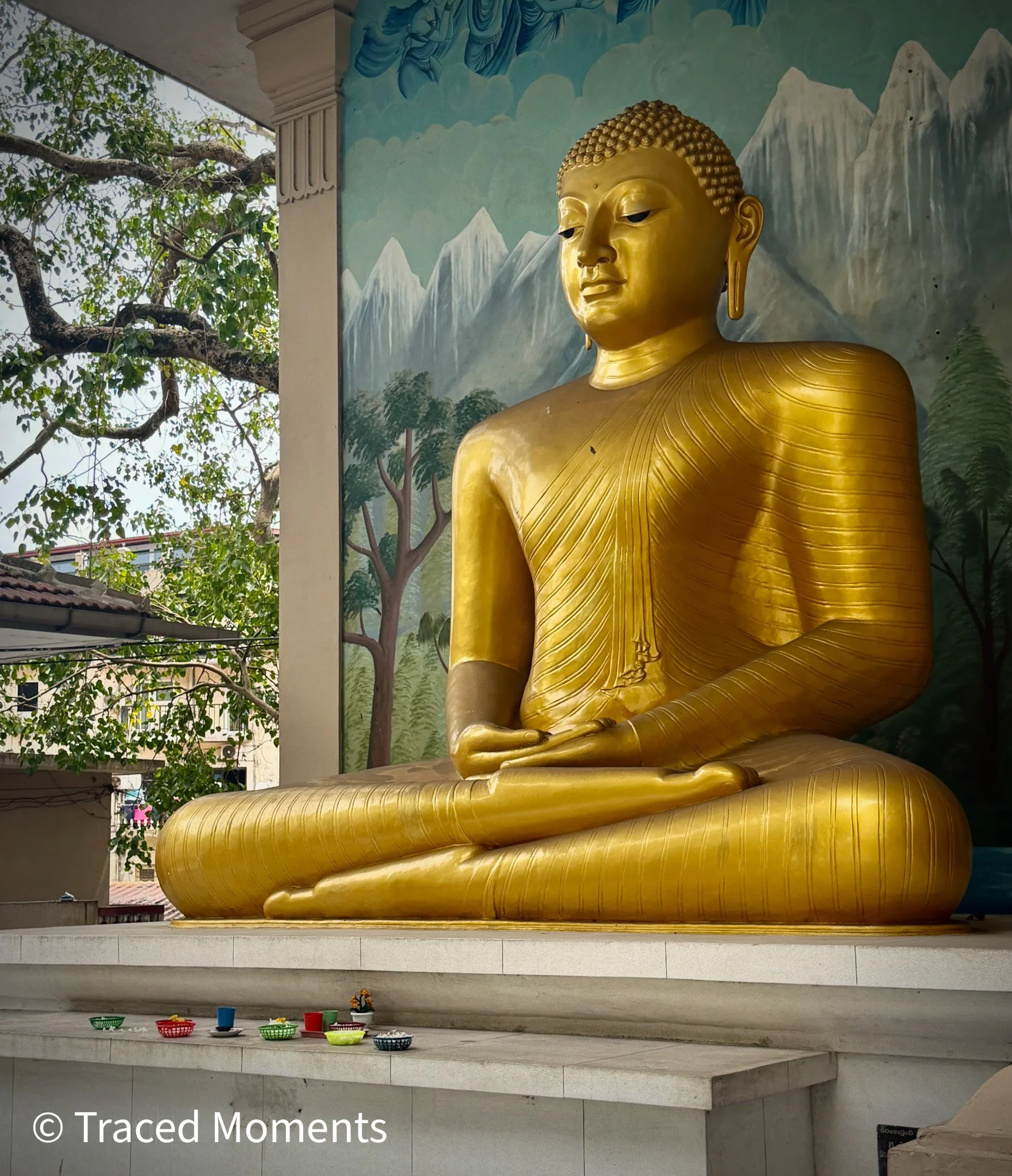
A statue of the Buddha — seated, standing or reclining — serves as a focus for reflection. The Buddha is not worshipped as a god, but honoured as the Enlightened Teacher. Sri Lankan Buddhists make a strong distinction between prayer — asking something of a god — and veneration or reverence.
2. A Stupa (Dagoba)
The stupa is the white dome rising above the temple grounds. It often houses sacred relics, but symbolically it represents far more — the Buddha’s enlightened mind and the path to awakening.
Its shape carries layered meaning:
• The square base represents earth
• The dome represents water
• The spire symbolises fire
• The tapering pinnacle represents air
• The top point represents space
Devotees walk clockwise around it, keeping the sacred structure to their right. You don’t enter a stupa — it is solid, containing relics within.
3. A Bodhi Tree (Ficus religiosa)
Most temples also have a Bodhi tree, said to be grown from cuttings of the original tree under which the Buddha attained enlightenment. Its presence represents awakening and continuity. You’ll often see offerings of flowers and small oil lamps placed at its base.
Together, these three elements tell the whole story:
The Teacher. The Enlightened Mind. The Moment of Awakening.
The Big Buddhas
Sri Lanka also has a fondness for large Buddhas — and not subtly large. Over the last four weeks, we’ve seen:
• Towering standing Buddhas carved into cliffs
• Seated meditation Buddhas overlooking valleys
• Reclining Buddhas stretching the length of cave walls
The scale reflects reverence — the vastness of wisdom and compassion.
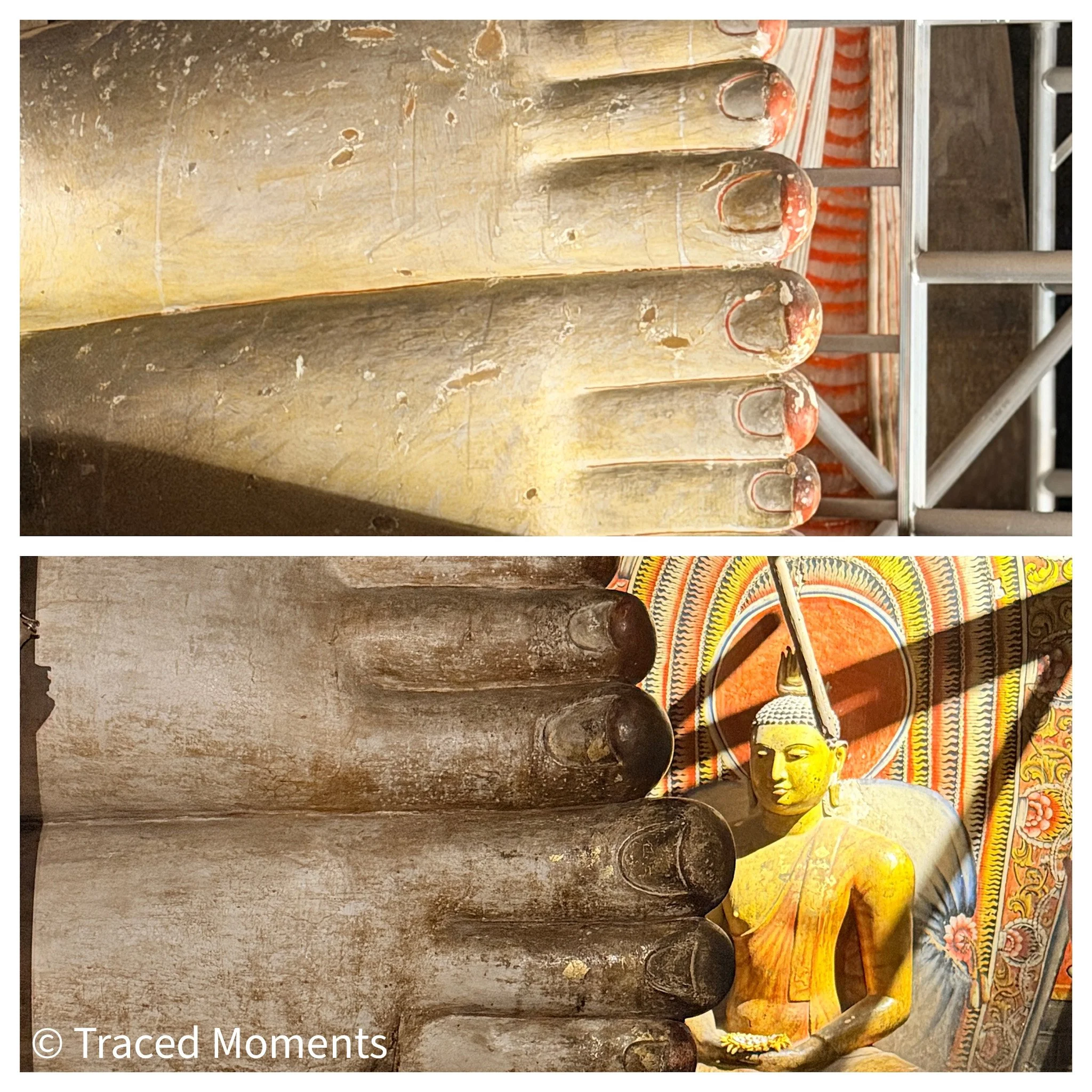
The Reclining Buddha — Look at the Feet
Reclining Buddhas usually depict the moment of Parinirvana, the Buddha’s final passing from the cycle of rebirth.
Here’s the detail most visitors miss:
• Toes perfectly aligned → The Buddha has entered final Nirvana
• Toes slightly staggered → He is resting, not yet in final passing
It’s a small detail. But once you know, you will always look.
Hinduism: Colour, Rhythm and Devotion
Hinduism is practised by about 12–15% of the population, primarily among Tamil communities in the north and east. There are approximately 1,500–2,000 Hindu temples (kovils) across the country.
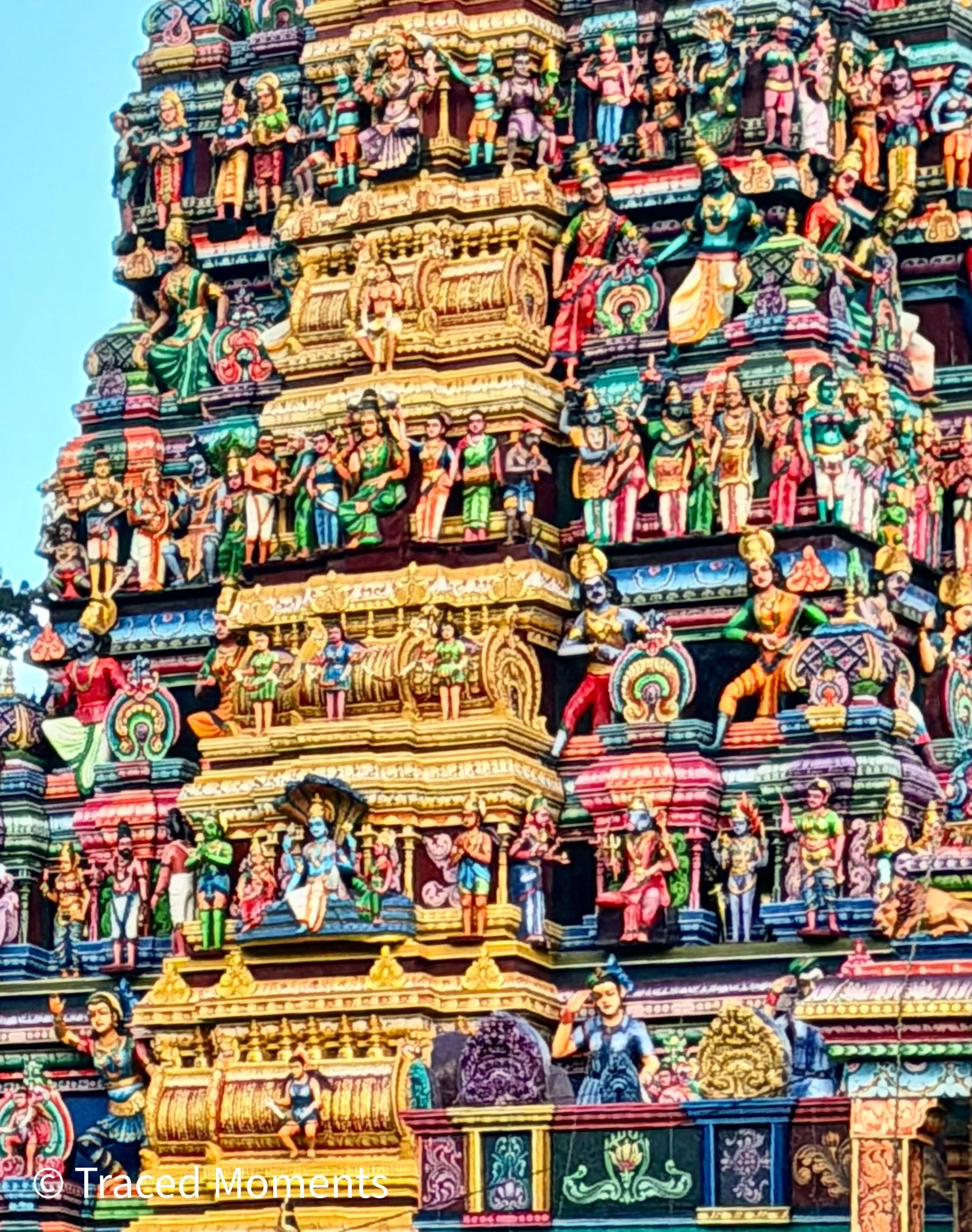
Where Buddhist temples often feel serene and minimalist, Hindu temples are exuberant. Towering gopurams are layered with brightly painted deities. Inside, bells ring, drums beat, and incense fills the air.
Worship here is active and expressive — offerings of fruit and flowers, fire rituals, vows made and fulfilled. Deities such as Shiva, Vishnu and Murugan are deeply revered.
Hindu temples feel vibrant. Immediate. Personal.
Islam: Trade, Community and Call to Prayer
Islam arrived over a thousand years ago through Arab traders. Today, about 9–10% of Sri Lankans are Muslim, and there are roughly 1,500–2,000 mosques across the island.
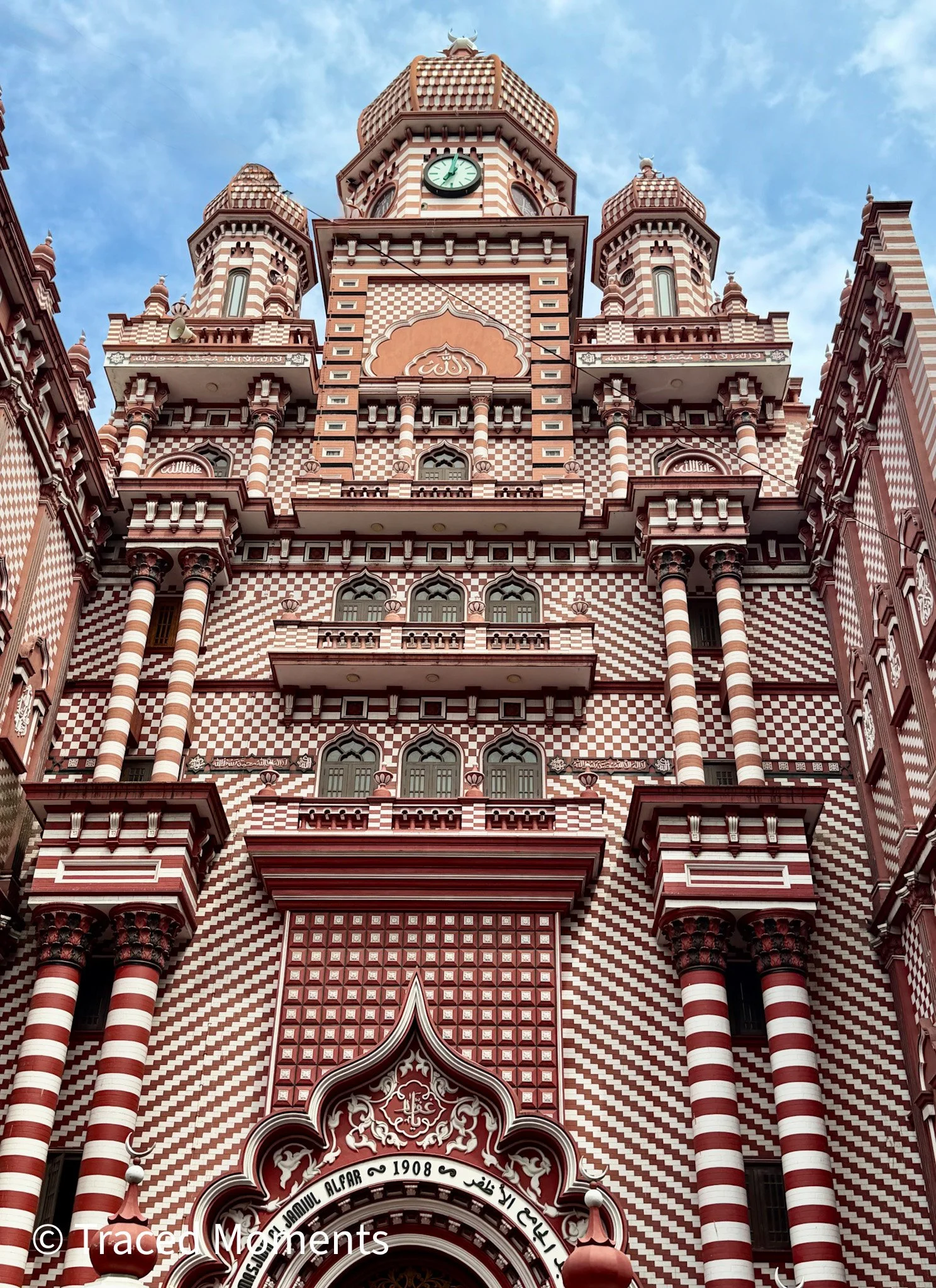
Mosques are especially visible in coastal towns and urban centres. Some are simple and whitewashed; others — like Colombo’s striking red-and-white Jami Ul-Alfar Mosque — are architectural landmarks. In Colombo, mosques are plentiful in the Pettah Market area, where Muslims dominate the commerce.
Inside these mosques, there are no statues. Islamic design favours geometry, pattern and calligraphy. The call to prayer gently marks the rhythm of the day.
Christianity: A Coastal Legacy
Christianity accounts for about 7–8% of the population, with roughly 6–7% identifying as Roman Catholic. There are approximately 1,200–1,500 churches across the island. Christianity was brought to Sri Lanka by the Portuguese back in the 1500’s.
Catholic communities are especially strong along the west coast — Negombo is sometimes called “Little Rome.” Many churches reflect Portuguese and Dutch colonial influence, softened by tropical light and palms.
Living Side by Side
Although Buddhist temples outnumber other places of worship by roughly four to one, what makes Sri Lanka compelling isn’t just the statistics — it’s the proximity.
A stupa gleaming white under the sun.
A Hindu temple exploding with colour.
A mosque’s minaret rising above a market.
Church bells on Sunday morning.
During our time here, we saw religious houses everywhere — not just grand monuments, but small shrines tucked into neighbourhoods, temples beside busy roads, mosques and churches woven into ordinary streets.
What struck me most isn’t their differences, but how physically close they often are. Different beliefs. Same towns. Same schools. Same markets. While it’s clearly a sign of how the different communities live together peacefully, as one guide also told me, “don’t be fooled, these religious houses also serve as marketing beacons, with each religion marking its spot and defining its space by placing a temple, mosque or small church somewhere”.
Sri Lanka’s history has not always been peaceful. Religion, ethnicity and language have, at times, divided communities deeply. But what we observed over the last month, across the areas we travelled, felt different — more layered, more shared. People living side by side. A quiet sense that the trajectory now leans more toward coexistence than conflict,
Faith here isn’t abstract or theoretical. It’s daily, practical and visible — present in the laughter, the small kindnesses, and even in the greeting “Ayubowan,” which means “may you have a long life.”
Seeing these sacred spaces standing near one another felt like its own quiet symbol — imperfect, evolving, but hopeful — and perhaps something many other parts of the world could learn from.
And yes… I’ll still always check the toes.